Back in January Holly introduced us to an interesting fact about prime numbers and square numbers. This is something that was discovered by a famous mathematician from Toulouse called Pierre Fermat. The green prime numbers circled here can all be made by adding two square numbers together:
Today in 4G we checked this:
And here are all the ones we did:
Showing posts with label prime numbers. Show all posts
Thursday, 12 March 2015
Monday, 9 February 2015
Prime Fall 2
Some of us are getting pretty good at Prime Fall. So, here's another level: Prime Fall 2. The difference is that this time the numbers go up to 30, not 20, which makes things a lot busier!
As before, your job is to hit the numbers that aren't prime.
And, as before, you can share how well you did in the comments below.
As before, your job is to hit the numbers that aren't prime.
And, as before, you can share how well you did in the comments below.
Monday, 19 January 2015
More on Holly's post
Holly posted a fantastic post at the weekend about square numbers and prime numbers. If you haven't had a look at it yet, it's really interesting: have a look! Also read the comments.
It's certainly made me, Mr Gregg, think. In 4G today we looked at the numbers Holly's dad had talked about, and used it for our counting circle:
These are all the "four times table plus one" numbers, they are the " 4 times something + 1" that Holly's dad talked to her about.
We looked for prime numbers among these. We used a 100 square, but it would have been better on a hundred-rectangle like this:
All the prime numbers are circled. The ones that we're looking at are the green ones. (It never works with the red primes.)
Then we found that all of them could be made by adding two square numbers.
1 4 9 16 25 36 49 64 81
Can you do it? If you can make any of those green primes by adding two square numbers, write it in the comments below.Thursday, 15 January 2015
Prime Fall
I made this little game by writing code on Scratch.
Let the prime numbers fall.
Hit the other ones.
You get points each time a prime number falls all the way, and each time you hit one of the other numbers to split it up.
You lose points if you hit a prime number or let one of the other ones fall.
Use the arrow keys to move around.
If you get a good score, write in the comments what you got!
NEW! - Want a harder level? Try Prime Fall 2.
Let the prime numbers fall.
Hit the other ones.
You get points each time a prime number falls all the way, and each time you hit one of the other numbers to split it up.
You lose points if you hit a prime number or let one of the other ones fall.
Use the arrow keys to move around.
If you get a good score, write in the comments what you got!
NEW! - Want a harder level? Try Prime Fall 2.
Tuesday, 16 December 2014
More clock flowers
We used the Scratch Clock Flower Project and noticed lots of things - have a look at our comments.
Then we together looked at which size jump "fitted", so that the jumps only went round once to create nice neat petals.
We scanned them and coloured them in quickly on Paint:
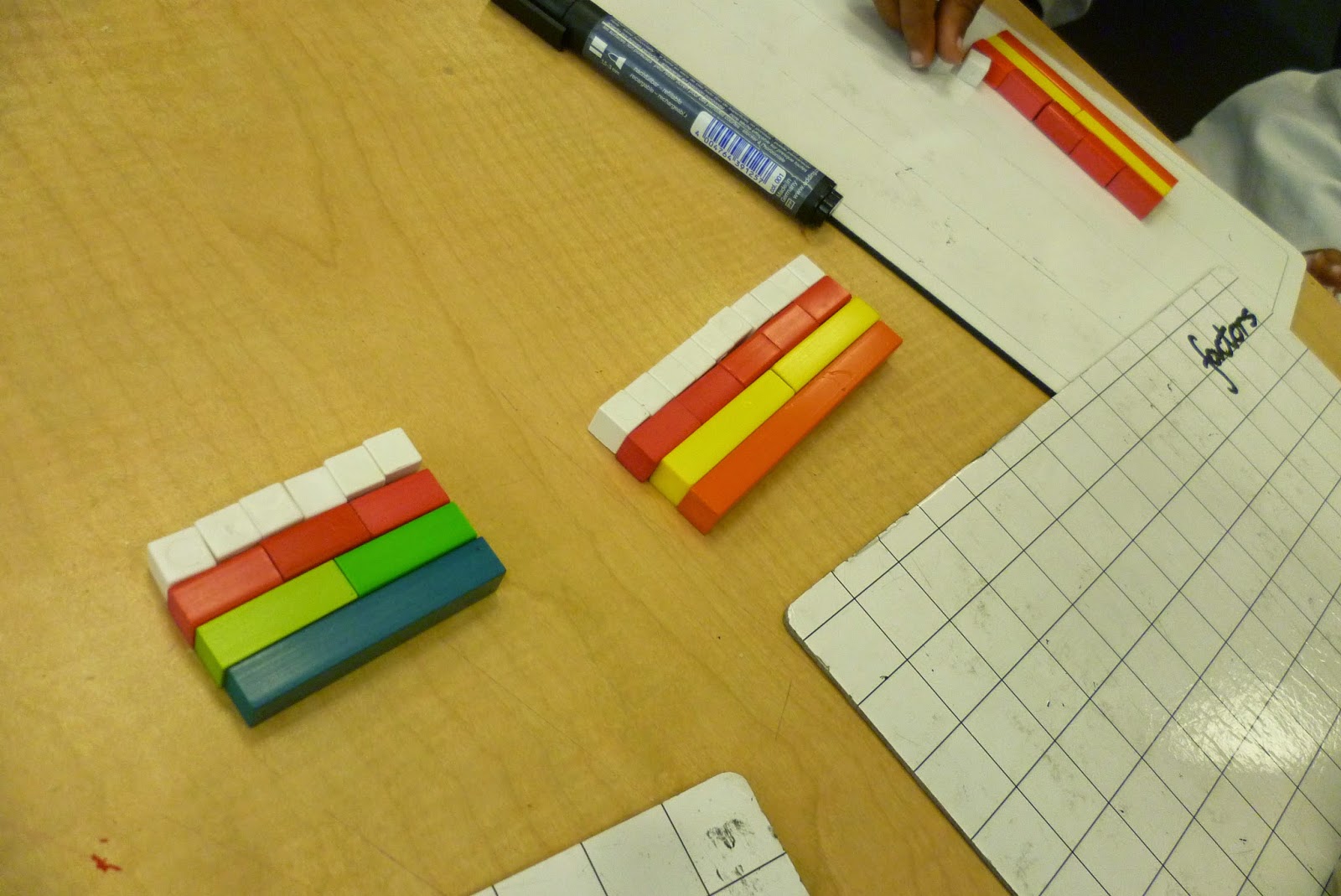
Meanwhile, Rose, Marie and Gabrielle volunteered to try a similar thing with Cuisenaire rods. Their line of rods had to be 60 long. Only numbers that "fitted" exactly into sixty could be added.
Then we together looked at which size jump "fitted", so that the jumps only went round once to create nice neat petals.
We scanned them and coloured them in quickly on Paint:
Meanwhile, Rose, Marie and Gabrielle volunteered to try a similar thing with Cuisenaire rods. Their line of rods had to be 60 long. Only numbers that "fitted" exactly into sixty could be added.
They did a great job. The line at the top is the twelves, made of ten+two because we don't have any twelve rods. Can you see any other big factors of sixty that are missing?
Sunday, 14 December 2014
Clock Flowers on Scratch
After some class work on clock flowers last week, I wrote a little bit of code on Scratch to make some more. You can make "petals" for the flower that have jumps of between 1 and 22. Try it out. Click the green flag to begin.
What do you notice?
What do you wonder?
What do you notice?
What do you wonder?
Saturday, 6 December 2014
Prime Climb again
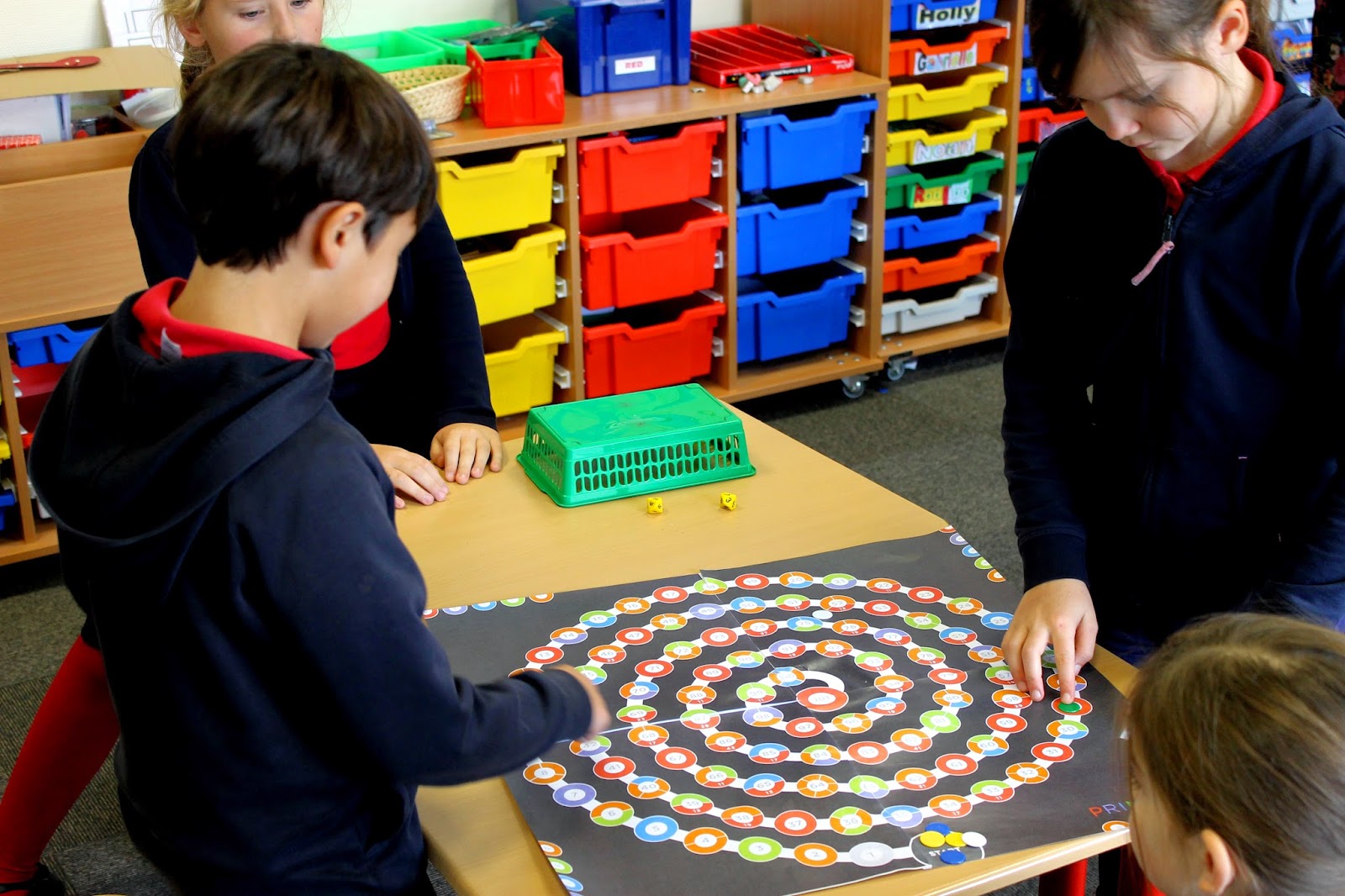
We've been playing Prime Climb again in Year 4.
It's a great game where the aim is to get your pieces to number 101. You roll two dice, and you can add, subtract, divide or multiply the number you're on by one of the numbers rolled.
If you land on a prime number, you pick up one of the Prime Climb cards. Excitement mounts as the players get towards the centre, and we find it hard to stay in our seats!
Tuesday, 25 November 2014
Numbers
Miss Whittaker is up on the ladder putting numbers up around the room. Can you spot the "deliberate mistake"?
Can you say which numbers here are prime numbers?
Friday, 14 November 2014
Explaining factor trees
Prime Climb
Tuesday, 4 November 2014
Factor Trees
Here are some of our factor trees. The flowers at the ends of branches are the prime factors of the number.
Some numbers are prime to start with and so have no branches, no tree.
Monday, 13 October 2014
Thirty
What is the smallest number that has two and five as factors?
Yes, ten.How about the smallest number with two, three and five as factors?
Yes, thirty. (Mr Gregg had cut some special thirty-rods.)
We had no fifteen rods. Can you see how we've made fifteen?
Oops, we've missed one... six is a factor too!
Now let's make a factor tree of thirty...
Thursday, 9 October 2014
Explaining factors and primes
We now understand that some numbers are...
Here we are explaining it (click on the pictures to see the videos):
Here's some pictures of us making our number walls. Not all of us wanted to do videos this time.
Subscribe to:
Posts (Atom)